October is a lovely month for grayling fly fishing on the Welsh Dee. The grayling are usually feeding hard, the weeds are dying back, and the autumn colour makes even a blank day pleasant. This month I’ve fished my favourite stretches of the Welsh Dee at Llangollen and Bangor-On-Dee, and the grayling didn’t disappoint.
Here’s where I fished and what worked…
Grayling Fly Fishing in October at Llangollen
After a spell of very wet weather towards the end of September, things dried up and the river dropped back to a fishable level (0.51m Manley Hall gauge). This was ideal for grayling fly fishing in October with a friend, Buddy, who’d been absent from the river for a long while. While Buddy’s plan was salmon fishing, my target was grayling. So, we headed for a grayling hot spot, the Top Pool.
Fishing the Top Pool
There was a chill in the air and we spotted a few small olives hatching, but didn’t see any rising fish as we walked upriver to the Top Pool. Therefore, I decided to search the pool by fishing a team of 3 wet flies on a floating line tipped with a 7ft 4X tapered copolymer leader with two 3ft lengths of 3lb nylon that make two droppers plus the point fly.
- Point: size 14 Black Hopper
- Middle dropper: size 14 Pearl Ribbed March Brown Spider
- Top dropper: size 16 orange tagged black midge
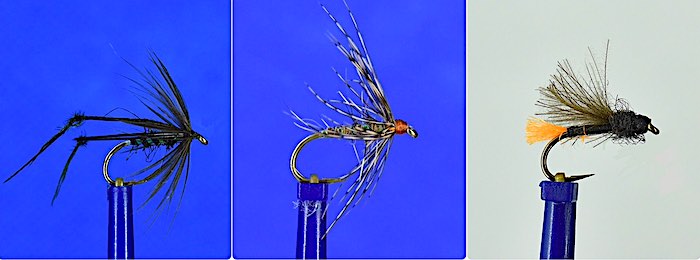
I started fishing the shallow riffle section at the head of the pool with the wet flies, casting them across towards the far bank, controlling the downstream swing by periodically putting upstream mends into the line.
Initially, I caught a few juvenile grayling and salmon parr on the March Brown Spider and Black Hopper. Then in a deep pocket behind a large submerged rock, my line tightened into a bigger fish that swirled on the surface and took off downriver. After a short struggle, I gained the upper hand and guided a beautiful grayling to the net. It had fallen for the March Brown Spider on the middle dropper.
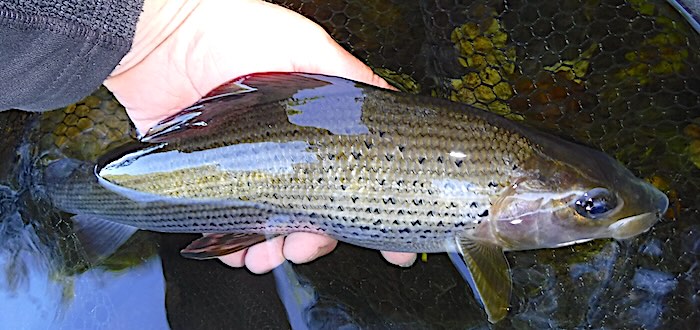
Fishing the remainder of the pool to its tail produced a few grayling ranging from 10 to 20cm in size mainly on the March Brown Spider. Then in the tail of the pool I caught another lovely grayling on the orange tagged midge and lost good one.
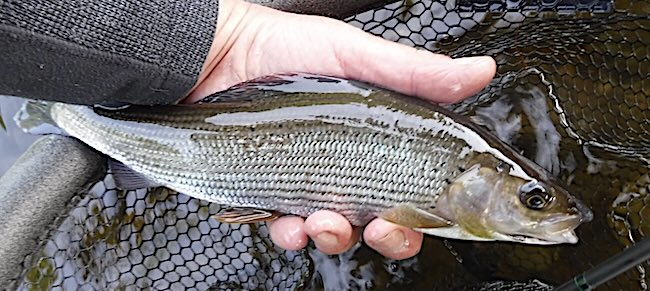
Buddy didn’t connect with any salmon but did see one swirl close to the far bank. However, he did catch a nice grayling on a black spider.
My next trip to fish the Welsh Dee at Llangollen was on the 12th October. The river was running off after heavy rain a few days earlier and the level had dropped back to 0.61m (Manley Hall gauge) and was running clear. The plan was to fish the upper beat for grayling..
Fishing Dee Farm
The river bank at Dee Farm was heavily overgrown and as a result most of the pool is not fishable. Nothing was rising, so I decided to fish the fast water at the head of the pool with two nymphs on a Euro leader setup (nymphs spaced 50cm apart on 4lb fluorocarbon tippet).
- Point: size 12 pheasant tail nymph, 4mm copper bead
- Dropper: size 14 hare’s ear nymph, gold bead
I started fishing the streamy water near the top of the pool. In the slack pocket behind the large mid-river rock, my line darted upriver and I lifted into a solid fish.
A grayling boiled on the surface, then bolted for the fast water.
It wasn’t easy keeping my balance navigating the slippery boulders to guide the grayling into the slack water and then the net. It had taken the small hare’s ear on the dropper.
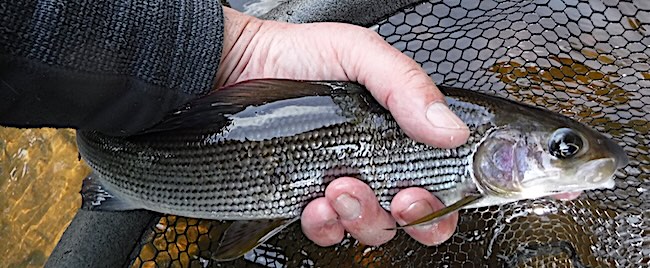
Fishing the rest of the fast water produced a couple of small grayling on the hare’s ear.
Fishing Glide Pool
Next, I walked downriver to fish the streamy riffle at the head of the Glide Pool. Most of the streamer weed in the riffle had started to die back, so it was easier to fish the nymphs cleanly through the water.
As I searched the water between the weed, my first take came as the nymphs drifted through a seam of slacker water. A grayling boiled on the surface and bolted downriver using the current to its advantage. After a few dicey moments, I netted a lovely grayling that had taken the pheasant tail nymph on the point.
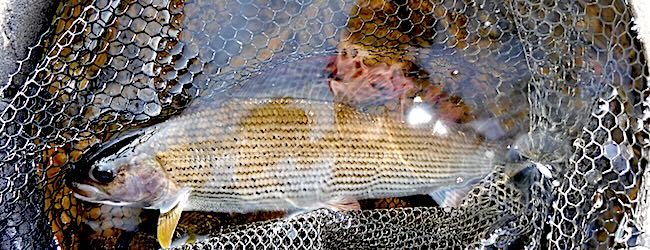
The rest of the riffle gave me two smaller grayling which took the hare’s ear on the dropper, before I walked further downriver to fish the Pipe Pool.
Fishing the Pipe Pool
While having a snack I spotted a couple of grayling rising in the tail of the pool and picking off what looked like small olives. This signalled a change in method from nymphing to dry fly fishing.
So, I set up my Hardy Marksman 10ft 4# fly rod to fish a size 14 CDC Olive Emerger on a 9ft 5X tapered leader with a 3ft length of 4lb fluorocarbon tippet tied on the end.
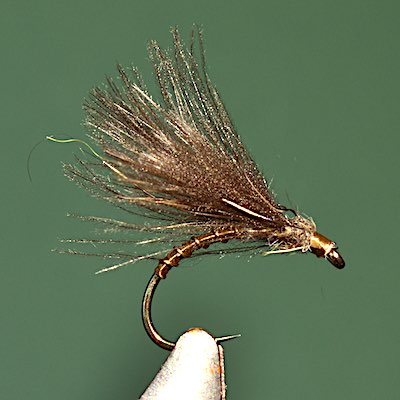
The fly was hard to see on the water, but I saw a fish rise where I thought it was and raised the rod on instinct. The line tightened and the rod bent into a nice grayling as it shot upriver into the deeper water. A short struggle ensued before the beautiful grayling was netted.
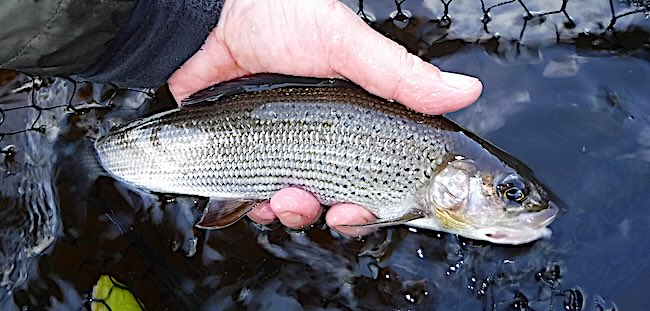
The commotion had put the other rising fish down, but prospecting upriver with the CDC olive produced another smaller grayling near the head of the pool.
Grayling fly fishing in October at Bangor-On-Dee
I hadn’t fished the Village beat at Bangor-On-Dee all summer because it had just been too hot, so I put that right now it’s much cooler. After some refreshing rain, the Dee had dropped back to 0.55m (Manley Hall gauge). It was late morning when I arrived at the river and it was overcast but the weather was showing signs of brightening up.
Fishing Dukes Pool
The river was running clear, and no flies were coming off the water at Dukes Pool. So I set up my 11ft 3# Vision Nymphmaniac fly rod to fish three nymphs, 50cm apart on 4lb fluorocarbon:
- Point: size 12 olive nymph, 4mm bead
- Middle dropper: size 14 purple-collar pheasant tail nymph, 3mm bead
- Top dropper: size 16 hare’s ear, 1.5mm silver bead
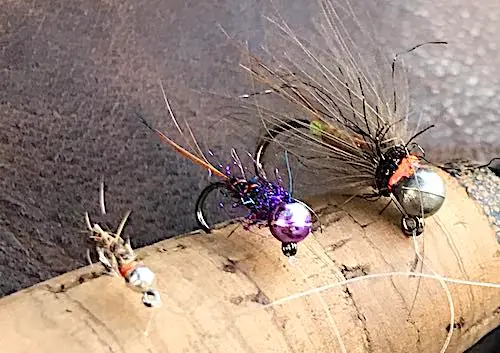
I started in the riffle leading into the pool and concentrated on the deeper run along the far bank. After missing a couple of takes, the line stopped as it drifted over the drop-off. The rod bent into a grayling that used the main flow to run downriver. I guided it into the net, and it had taken the pheasant tail on the middle dropper. Two more followed from the rest of the pool, all on the same fly.
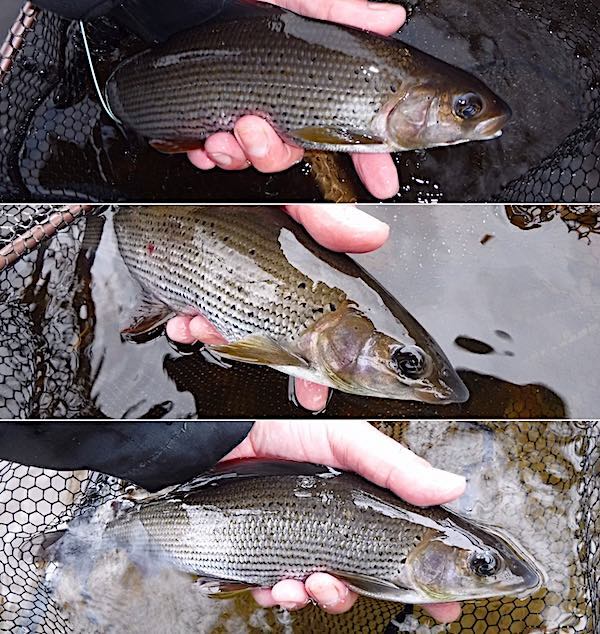
Fishing Twll Run
After lunch I walked downriver to Twll Run. There was still no surface activity, so I started at the head of the riffle with the same team.
It was quiet until I reached the drop-off, where the flow slows. In the crease between the fast and slow water the line darted sideways, and what felt like a heavy fish took off. It turned out to be a grayling and trout double hook-up. The trout had taken the hare’s ear and the grayling had taken the pheasant tail.
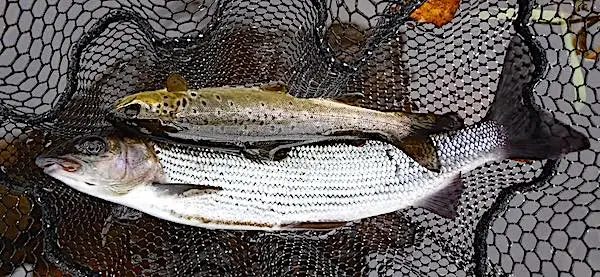
I didn’t have any more takes fishing the remainder of the run. At 3pm, with the temperature falling, I headed home happy after my first trip of the autumn to Bangor-on-Dee.
Key takeaways from grayling fly fishing in October?
- Check for rising fish first. A few up-winged flies in slack water were enough to get grayling feeding at the surface at Llangollen.
- When the water is clear and nothing is hatching, nymph. A three-nymph team caught the fish in both riffles and runs.
- Pheasant tail and hare’s ear were the stars. Between them they took almost every fish on the nymph rigs.
- Dying weed makes life easier. October is a good month to fish riffles that were awkward in summer.
Want to see how this changes in the colder weeks ahead?
Read my top 11 grayling flies for November, or the grayling fly fishing guide. Also, watch out for my next post on grayling fishing in November or subscribe and get it delivered to you by email.
If you’d like to try the Welsh Dee yourself, my page on day ticket fishing at Llangollen is a good place to start.
What’s worked for you this October? Let me know in the comments.