
Synopsis
Eleven tried-and-tested grayling flies for November, matched to four situations: mild or cold, low or high water that you might experience on the Welsh Dee. You get dry flies and spiders for mild, clear days, Euro nymphs for cold or coloured water, and a squirmy worm for emergencies.
Introduction
The clocks have gone back, the nights are drawing in, and the Welsh Dee is quietly at its best for grayling. Hatches thin out in November, so the fish switch to feeding on the riverbed (nymphs, larvae, worms, etc), building up condition ahead of spring spawning.
However, when the river is running clear on mild November days (ca. 10+ °C), you might be lucky to see a hatch of any of the following flies…
Upwing Flies
- Large Dark Olive
- Sherry Spinner
- Iron Blue (mild days)
Sedges & Others
After years of fishing log notes, I found that two things decide my fly choice more than anything else: how cold it is and how high the river is running on the Manley Hall gauge. Of the two, river level matters most.
So rather than a random list of favourites, here are my 11 Go-to November Grayling Flies, sorted into four simple scenarios, with tying recipes and tips on where to fish them.
Key Takeaways
- In November river level, is the primary variable on the Welsh Dee that often dedicates fly choice for grayling fly fishing.
- Mild and low (below 0.6m): Look for rising fish. Try an Elk Hair Caddis, F-fly or Griffith’s Gnat, or a three-fly wet team of black hopper, pearl-ribbed March Brown and Treacle Parkin.
- Cold and low: Fish tight to the riverbed with Euro nymphs such as the pheasant tail, red nymph and Hare’s Ear shell-back.
- Mild and high (0.6 to 1m): Dries in the slower pool edges if fish are rising. Otherwise use heavier Euro nymphs, and a pink squirmy worm when the river is carrying colour.
- Cold and high: Fish the slacker sections with a heavy jig-back on the point to pull the team down.
- Keep a fishing log. Recording temperature, level and fly will tell you more than any list, mine included.
By the way, for the bigger picture on tackle, tactics and where these flies fit, see my grayling fly fishing guide.
Grayling flies for November:
November is the last month of Autumn, but the weather on the Welsh Dee can range from a mild 17 °C to a wintry sub-zero (reference – for mid-November in Llangollen, the long-term historical average high & low temperatures are 9 °C & 5 oC, respectively).
This dichotomy of weather conditions shows up strongly in my fishing log, which influences fly choice and fishing technique during November.
In addition to temperature, there were three other variables to consider when deciding on the best approach:
- River level
- Water clarity
- The quantity of fallen leaves in the river
However, after analysing my fishing log data in several ways, the river level was the most important variable.
Therefore, I’ve split my November fly recommendation into four subgroups based on:
“Temperature and River Level”
Here’s a quick look up table with link to the relevant section….
| Conditions | River level (Manley Hall) | Methods | Go-to Flies | Where to fish |
|---|---|---|---|---|
| A) Mild 10oC & above | below 0.6m | Dry flies or a three-fly wet team | Dry: Elk Hair Caddis, F-fly, Griffith’s Gnat Wet: Black Hopper (point), pearl-ribbed March Brown (middle), Treacle Parkin (top) | Fast water into the pool, alongside weed beds, rocks and ledges, and the glide into the tail |
| B) Cold, below 10oC | below 0.6m | Nymphing | Pheasant Tail Nymph (orange tag), Red Nymph, Hare’s Ear shell-back | Close to the riverbed, where the grayling are feeding |
| C) Mild, 10oC & above | 0.6m to 1m | Dries if fish are rising in slower water, otherwise heavier nymphs | Flies from A for rising fish, heavier versions of the nymphs in section B, and a Pink Squirmy Worm when the river is carrying colour | Slower sections of the pool for dries, the riverbed for nymphs |
| D) Cold, below 10oC | 0.6m to 1m | Euro nymphing with a heavy point fly | Olive Tungsten Jig-back (size 12) on the point, with the nymphs in section B | Slacker sections of the pool |
Tip: “Not sure which scenario you’re in? Check the Manley Hall gauge first, then the thermometer.”
A) Grayling flies for November on mild days when the river level is below 0.6m
On mild days (ca. > 10 °C), when the Welsh Dee is between 0.4 & 0.6m (Manley Hall gauge), graylings are likely to be seen taking flies at the surface.
Under such conditions, you can have a…
Grayling bonanza fishing dry flies & wet flies.
The flies that often work well include:
Grayling dry fly selection:
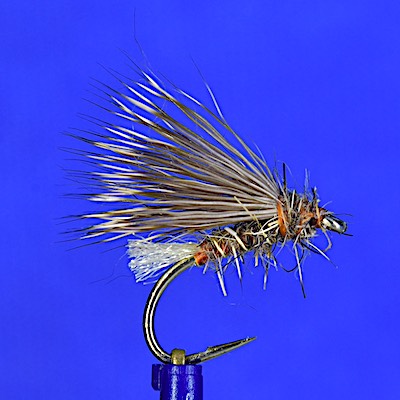
Elk hair caddis (cream tag)
- Hook: Kamasan B170 #12
- Thread: Burnt orange UNI 8/0
- Tail: Cream Anton yarn
- Body: Fox Squirrel dubbing
- Rib: Gold wire
- Wing: Natural Elk hair
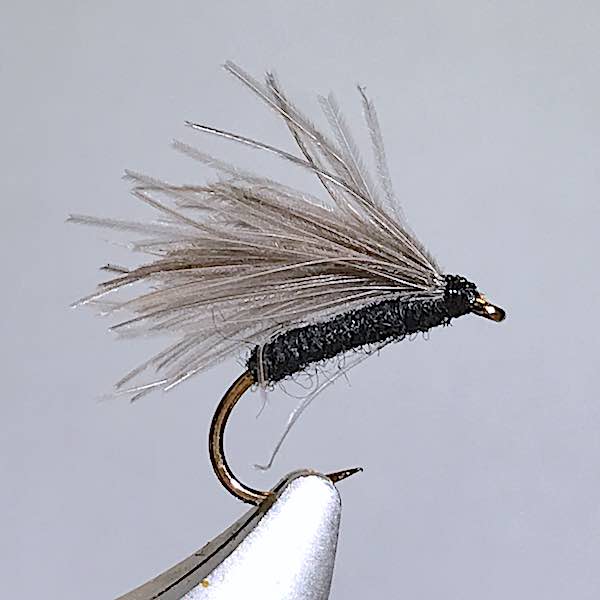
F-fly in various colours
- Hook: Kamasan B170 #16 & 18
- Thread: Black UNI 8/0
- Body: Fine dubbing (black, olive, etc.)
- Wing: 3 CDC feathers
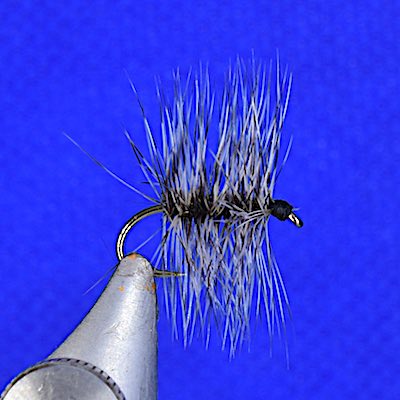
Griffith Gnat
- Hook: Kamasan B170 #18
- Thread: Black UNI 8/0
- Body: Peacock herl
- Hackle: Palmered Grizzle cock
Grayling wet Fly selection:
In November, my default recommendation would be to start with a three-fly cast on a 3lb copolymer leader (point: size 14, black hopper; middle dropper: size 14 PR – March Brown spider; top dropper: size 16, Treacle Parkin).

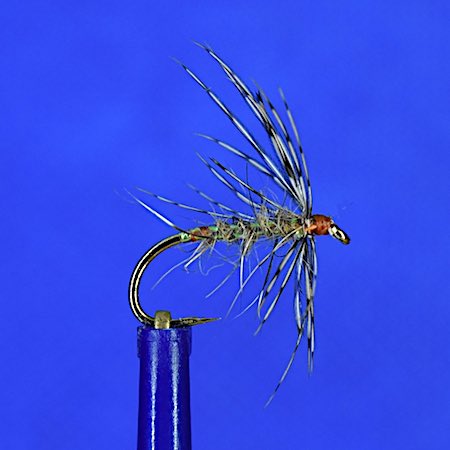
Pearl-ribbed March Brown Spider
- Hook: Kamasan B170 #14
- Body: Tan UNI-Thread 8/0
- Rib: Pearl Mylar #14 (1/32)
- Hackle: Brown partridge neck

Treacle Parkin (red-tag)
- Hook: Kamasan B170 #16
- Body: Brown UNI-Thread 8/0
- Tag: Red UNI-Thread 8/0
- Body: Peacock herl
- Hackle: Brown hen
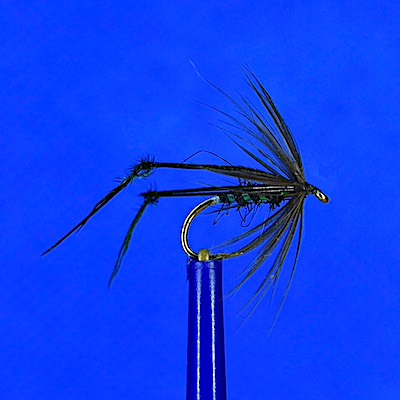
Black Hopper
- Hook: Kamasan B170 #14
- Thread: Black UNI-Thread 8/0
- Body: Black seal fur substitute
- Rib: Pearl Mylar #14 (1/32)
- Legs: Black pheasant tail
- Hackle: Black Hen
Where are the best places to fish the wet flies?
When the Welsh Dee is close to its summer level (<0.5m Manley Hall gauge), I focus my fishing in the following areas:
- The fast water leading into the pool
- alongside weed beds, large rocks, ledges, and snags
- the glide leading into the tail of the pool
Check out my wet fly fishing page for more information on how I fish wet flies.
B) Grayling flies for November on cold days when the river level is below 0.6m
On cold days (ca. < 10 °C) when the Welsh Dee is between 0.4 & 0.6m (Manley Hall gauge) grayling will be feeding close to the riverbed. Under such conditions, Czech (euro) nymphing usually outfishes the other methods.
The flies that work well include:
Selection of Grayling nymphs

Pheasant tail nymph (orange tag)
- Hook: Hends BL154 (#14 & 12)
- Bead: 2.5mm tungsten (silver & gold)
- Thread: Brown UNI-Thread 8/0
- Tail: 3 pheasant tail fibre
- Body: pheasant tail fibres
- Rib: Fine copper wire
- Thorax: Olive dubbing

Red nymph
- Hook: Hends BL 354 (#18 & 16)
- Bead: 1.5mm tungsten
- Thread: waxed red UNI-Thread 8/0
- Tail: Coq De Leon fibres
- Body: red UNI-Thread 8/0
- Thorax: Fox squirrel dubbing
- Wing case: Pearl Mylar 1/8”

Hare Ear shell-back nymph
- Hook: Kamasan B100 #14 & 16
- Bead: 2 – 3mm tungsten (pink, gold)
- Thread: 8/0 rusty orange
- Body: Hare Ear
- Back: Mylar tinsel
- Rib: Gold wire
A November grayling caught in Duncan’s pool on the Hare’s Ear shell-back:

C) Grayling flies for November on mild days when the river level is above 0.6m
On mild days (ca. > 10oC), when the Welsh Dee is between 0.6m to 1m (Manley Hall gauge), there is a chance that grayling are taking flies at the surface in the slower sections of the pools. Under such conditions, it is worth trying one of the dry or wet flies covered in section A above.
Otherwise, Czech (Euro) nymphing usually produces the best results. Czech nymphing is not everyone’s cup of tea, but when grayling are feeding on the riverbed, it’s the best way to catch them.
If the river is running clear, then I would typically use heavier versions of the Czech nymphs mentioned in section B.
When the Welsh Dee is carrying colour after a spate, it is necessary to fish large, heavy nymphs to reach grayling feeding close to the riverbed.
There are many patterns that work on the Welsh Dee – see Czech nymphing page. However, I’ve had many fishing trips where the only way to catch grayling is to use a squirmy worm.
Not my favourite fly, but it is worth having a few in your box because they will help you avoid a blank day

Pink Squirmy Worm
- Hook: Kamasan B100 #14 & 12
- Bead: 3.5 mm tungsten
- Thread: red UNI-Thread 8/0
- Body: Pink squirmy
Fishing the Dee Farm Pool in high water (1.1m) with a pink squirmy worm produced this lovely Welsh Dee grayling.

D) Grayling flies for November on cold days when the river level is above 0.6m
Cold days (ca. < 10oC), when the Welsh Dee is between 0.6m to 1m (Manley Hall gauge), are difficult fishing conditions. However, you can still catch a few grayling by opting for Czech (euro) nymphing.
Usually, I fish the slacker sections of the pool with a team of Czech nymphs with a size 12 XL tungsten jig-back on the point and sometimes on the middle dropper. This heavy point fly ensures the other nymphs are fishing close to the riverbed (i.e. those mentioned in section B).

Olive Tungsten Jig-back
- Hook: Hends BL124 (#12)
- Weight: XL-tungsten jig-back
- Thread: Claret UNI-Thread 8/0
- Tail: badger cock hackle fibres
- Tag – orange UNI-Thread 8/0
- Body: Olive synthetic quill
- Coating: UV – Varnish:
I used the above tungsten jig-back nymph on the point to drag a # 18 red nymph down to the river bed, which caught this lovely Welsh Dee grayling.

Round-up – Grayling flies for November
November grayling fishing on the Welsh Dee comes down to reading two things before you tie on a fly: the thermometer and the gauge.
Mild and low? Grayling will be looking up, so fish the surface.
Cold or high? Get down to the riverbed with a well-weighted nymph team, and keep a squirmy in the box for the days when nothing else will do.
None of these flies is exotic, and that’s the point. They’re patterns that have caught me grayling year after year, which makes them a safe place to start if you’re new to the river.
If you’re planning a trip, there’s excellent day-ticket water at Llangollen, and once December arrives my next post covers the flies for the colder, shorter days.
For more information on fly fishing for grayling on the Welsh Dee during autumn, check out the following posts:
- Grayling fly fishing in Autumn with a focus on the beautiful Welsh Dee
- Grayling fishing in November on the Welsh Dee & River Eden
Which flies are earning their place in your box this November? Tell me in the comments. I’d love to hear what’s working for you.
An excellent guide. It’s also suitable for fishing on my local river in Eastern Siberia.
Hi Alex,
Great to hear you enjoyed it.
Tight lines, Andrew
i do enjoy your posts and the flies best for the river Dee, but i do not tie flies and therefore struggle to find the flies you post about…names of the ones you show may be similar but looks and quality from the shops are not as impressive
Hi Kevin,
Great to hear you enjoyed the article. As long as shop bought ones look similar in colour and size I sure the grayling don’t mind.
Tight lines, Andrew
Hi Andrew, can’t add much to that comprehensive guide as the most successful flies I have fished on the Dee at Llangollen have mainly been the Griffith gnat( various sizes) and various weighted and unweighted nymphs. Pink coloured has done well for me. The biggest grayling I have ever caught was a few seasons ago and it was at Ddol Issa fishing for sea trout. It was starting to get dark and I hooked what I thought was a sea trout and I had a great fight on a very long line using a team of wet flies. It turned out to be beautiful grayling( around the three pound mark)on a size 12 Fiery Brown, a fly I used to catch a lot of sea trout on when growing up in Ireland. Unfortunately my fishing days on the Dee are now restricted,as age and fitness are starting to catch up with me. Anyway thanks for your blog and I still get a lot of joy just reminiscing of fishing days gone by , both successful and unsuccessful. There is an old saying” there’s more to fishing than catching fish”
Hi Liam,
Thanks for your comments on the flies you have found successful. I will tie a few of the Fiery Brown flies for sea trout fishing on the Dee next season. Some of the biggest grayling I’ve caught on the Welsh Dee at Llangollen were taken in the evening on surface lures while fishing for sea trout.
Good to hear you enjoyed the post. Tight lines, Andrew
Fantastic reading again.
I’ve ordered a selection of nymphs as close as I could get to those mentioned in above article so fingers crossed and let’s see what the lady of the stream brings.thanks andrew
Hi Andy,
Great to hear you enjoyed it and I hope the flies help you catch some good grayling.
Cheers, Andrew
Hi Andrew, thanks from such a comprehensive and informative website, I am heading to the Welsh Dee on Friday for my first ever visit, having read all of your excellent guidelines,I’m busy tying up fly’s to fill the gaps in fly box really looking forward to my day.
Hi Dave,
Great to hear you are finding the blogs helpful and interesting. The Welsh Dee is very high at the moment but with a bit of luck and some dry weather, it might be Ok by Friday.
Tight lines, Andrew
These should be good on the Annan. Grayling day 20th November. Just got into Grayling fishing last year, can’t wait.
Hi Steve,
Would be great to know how you get on with them.
Tight lines, Andrew
do you ever do long trotting with a centre pin reel
Hi Emrys,
A long time ago I did and it was good fun but now just focus on fly fishing.
Andrew
Excellent article Andrew, particularly liked the advice on river levels and temperature. Thanks!
Hi Ron,
Glad you enjoyed it and thanks for the feedback.
Cheers, Andrew
Morning Andrew, i have been fishing the fisheries for years and now im in my 60’s am fed up on the same old same old so going to join my local river fishing ath ADAA up here in aberdeen, as you prob know we have our own river DEE and the Don both mouth out only a few miles apart from the sea at Aberdeen city so other than rod and reel am starting a fresh so to speak, so just wanted to say its been great and very informative reading your blogs, i know all rivers are different, but its the try of fly and at what time of year to use them things like that help newbies on the river like me no end.
of course season on our rivers ends today 31/10 so will have all winter to get prepared so the more i read the better, o and i might be interested in buying some of your flies as others have said.
thxs for the great blogs
regards john mckenzie
Hi John,
It great to hear you have been enjoying my blog posts. I’ve never fished the Dee or Don in Scotland but I would suspect that the flies will work there too.
We’ve gone into lockdown now until December so will be doing more writing about fishing than actual fishing for the next month. Just hoping I can get out grayling fishing before Xmas.
Cheers, Andrew
Excellent as ever Andrew. Your experience definitely takes a lot of the guesswork out of how/when to fish the Dee.
Hi Nigel,
Great to hear that you have enjoyed the post.
Cheers, Andrew
Have you thought of publishing your work ? Very informative & I’d happily buy
Hi Bryan,
Thanks for your great feedback. The aim of the website and blog is to help others start or improve their fishing and because it’s it removes the cost barrier.
Cheers, Andrew