Subscribe to my blog
Make your life easier - my blog posts delivered directly to your inbox.
Hawker-Overend Fishing
How to Catch Grayling on UK Rivers
A complete guide covering the Welsh Dee and other UK rivers — best flies, tactics, tackle and where to find grayling through autumn and winter.
Thaymallus Thaymallus
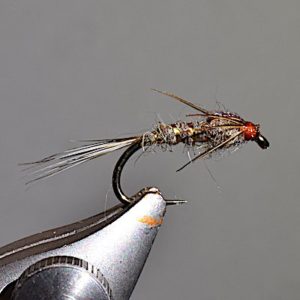
PTN, Hare's Ear, Jig Nymphs, Spiders, & Dry flies,
Euro Nymphing, Wet & Dry Fly Fishing
Clean, fast-flowing rivers with gravel
June - February
Grayling are often called the "Lady of the Stream," and once you've caught a few, you'll understand why. That sail-like dorsal fin, the delicate purple-grey colouring, the willingness to take a well-presented fly even in the depths of winter — grayling are one of the most rewarding fish you can target on a UK river.
I've been fly fishing for grayling on the Welsh Dee for over 30 years, alongside regular trips to the other Northwest rivers (River Ribble, River Eden, River Eamont, Calder etc.). Grayling are the fish that keep me fly fishing on the river once the trout season closes — as the water cools and the crowds thin out, they come into their own.
This guide brings together everything I'd want a newcomer to know about grayling fly fishing: where to find grayling, when to fish for them, the best graylingflies to carry, how to fish different water types, and grayling fishing tactics I actually rely on through autumn and winter.
It's written with rivers like the Welsh Dee and River Ribble in mind, but the principles apply wherever you're fishing for grayling in the UK, especially on Freestone rivers.
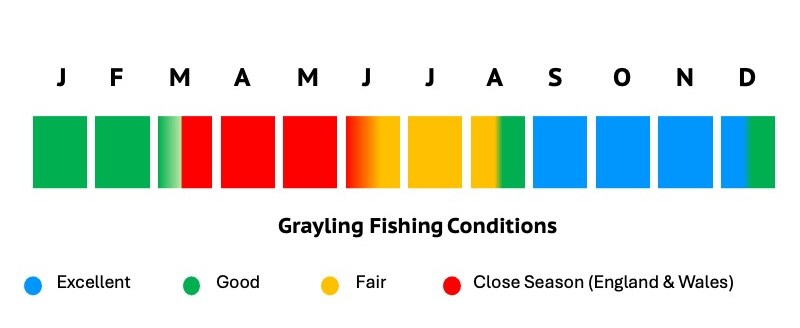
Grayling can provide sport across much of the year where fishing is permitted, but autumn and winter generally produced the best grayling.
Summer can produce good dry-fly and spider sport so long as the water temperature ins below 20oC.
Usually fly fishing for grayling is excellent. Fishing spiders and dry flies still works well.
In winter euro nymphing for grayling is usually the best approach. Focus your efforts in the steady flowing water.
The grayling fishing season in England & Wales is closed from the 15 March to 15 June but check the rules for the river you will be fishing.
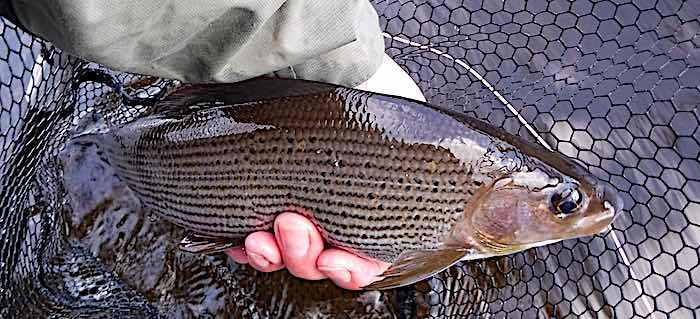
Autumn is one of my favourite times to be on the Welsh Dee and Ribble for grayling. As the water cools, fish become noticeably more active, spread across a wider range of water, and there are still days when a dry fly will take fish. It's also a great time to experiment with different techniques before winter sets in.
Autumn Guide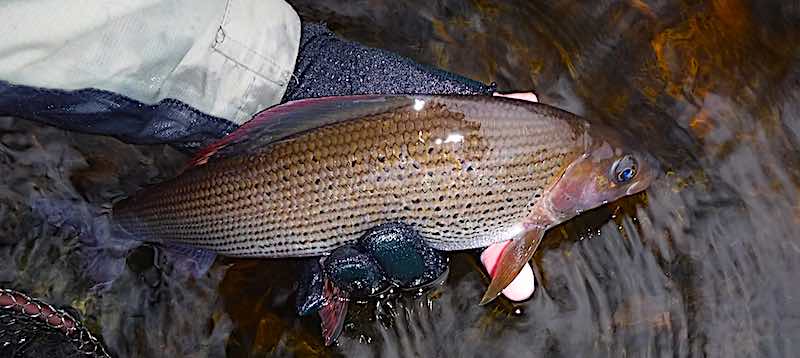
In Winter grayling really prove themselves. Cold water means slowing your fishing down (your retrieve, your drift, your expectations), and focus on the water where fish can feed without burning energy. Nymphing is usually the most reliable in the coldest months. Focus on deep glides, pool tails and steady runs.
Winter GuideGrayling are found in rivers right across Britain, though fishing quality varies a lot between rivers, beats and seasons. The rivers I fish and know best are featured in these guides:
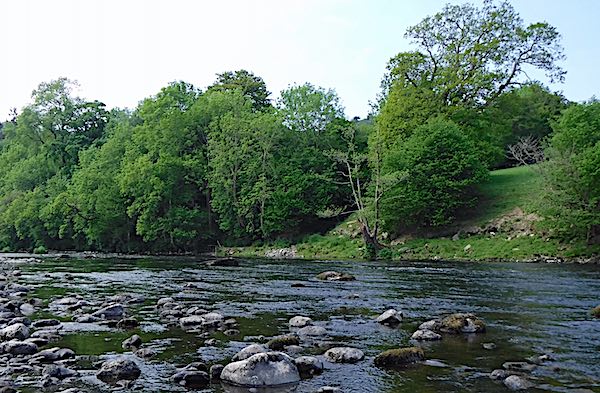
The Welsh Dee and its tributaries offer great grayling fly fishing. It's one of the best grayling rivers in Europe and is the venue for the annual Hanak International Grayling Festival. The river level is controlled by four large reservoirs and always has good water flow even during prolonged dry conditions.
Read Guide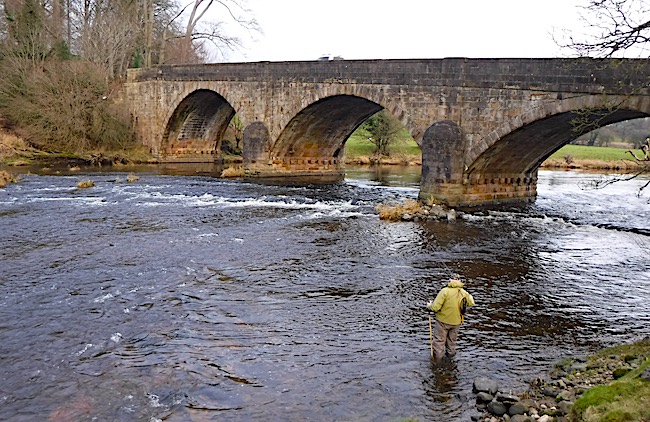
The River Ribble starts in the Yorkshire Dales and flows west through Lancashire. It has a healthy population of grayling, is blessed with good hatches of fly throughout the season, making it great for fly fishing. It is spate river that rises quickly after heavy rainfall but it also quickly drops after a few days of dry weather.
Read GuideBeyond those, grayling fishing is also well regarded on rivers across Yorkshire, Derbyshire, the Welsh borders, and Scotland. Wherever you fish, always check the rules for that specific river, beat or club before you go. Grayling fishing permissions and close seasons vary considerably from one fishery to the next.
Good grayling fishing starts before your first cast. Rather than tying on a fly and wading straight in, spend a few minutes studying the water. Changes in depth, current speed, riverbed composition, water colour, surface texture and current seams all tell you something about where grayling are likely to be lying and the approach to take.
It's not a hard rule, but a current moving at roughly walking pace is often a good starting point for water where grayling will hold and feed comfortably.
Find the seams. Where faster and slower water meet, food gets concentrated. These seams are worth fishing carefully, especially alongside deeper water.
Look for subtle depressions. A run that looks shallow from the bank can hide deeper pockets that are hard to see. A small change in depth is often enough to create a genuine holding area. It's usually these subtle spots, not the obvious ones, where the more experienced angler finds fish.
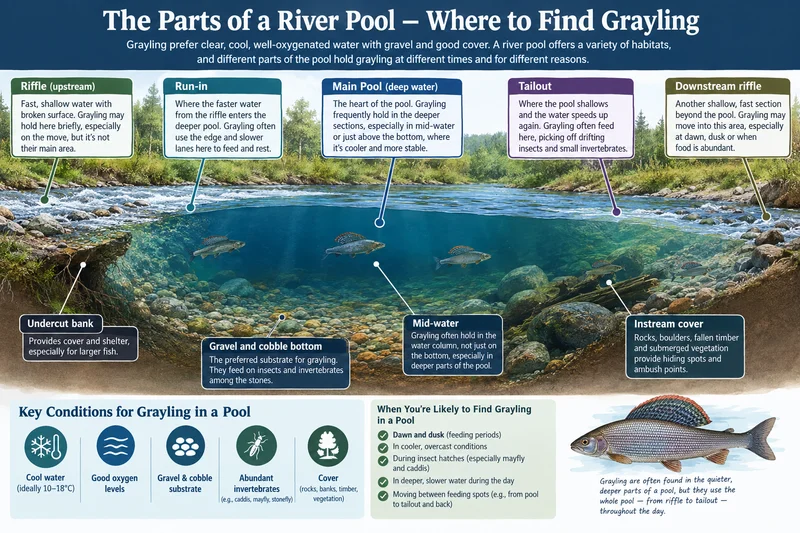
The drop-off zone (Run-in), where the river depth suddenly increases, at the head of the pool is one of my favourite places to fish because it often hold the bigger fish, especially when food is drifting down from the riffle section. Large grayling tend hold there because they get first dibs of any food and the feel safer in the deeper water.
The following inforgrahic summarises the key features of a pool to focus on when fly fishing for grayling...
For more on understanding what's actually happening in the water, my piece on kick sampling and river insects is a useful companion to this section.
Beyond those, grayling fishing is also well regarded on rivers across Yorkshire, Derbyshire, the Welsh borders, and Scotland. Wherever you fish, always check the rules for that specific river, beat or club before you go. Grayling fishing permissions and close seasons vary considerably from one fishery to the next.
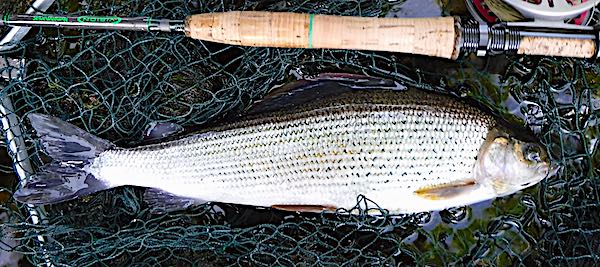
Precise, direct and deadly method to catch grayling throughout the season. Often the most effective compared to the other techniques during autumn, winter, and when the river is coloured. Ideal for grayling holding in deep runs, pool tails, steady glides, faster seams and gravel runs.
The technique keeps you in close contact with your flies and lets you present them right down near the riverbed. Your flies need to travel naturally through the feeding zone, with just enough contact to detect a subtle take without dragging them unnaturally through the water.
For an in-depth breakdown check the link to my guide...
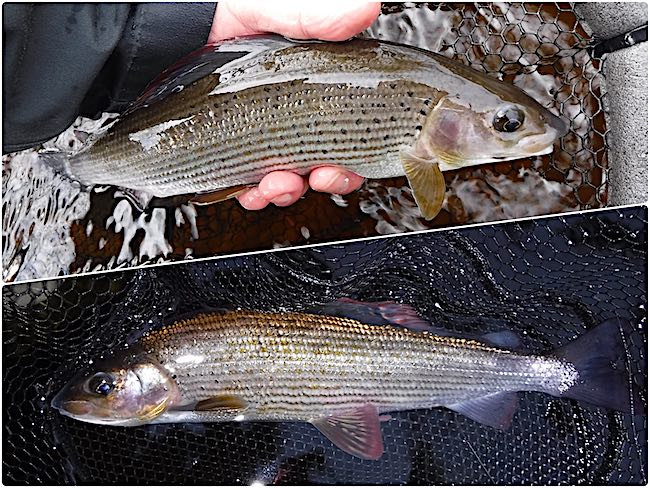
Ideal in moderate flows and a great way to cover water. Wet flies work well when fish are feeding on emerging insects. Cast across or slightly downstream and let the flies swing naturally through the current. Traditional wet fishing is an enjoyable way to cover water, because you're presenting flies through likely lies rather than casting to individual fish you can see.
An in-depth breakdown is given in the following detailed guide..
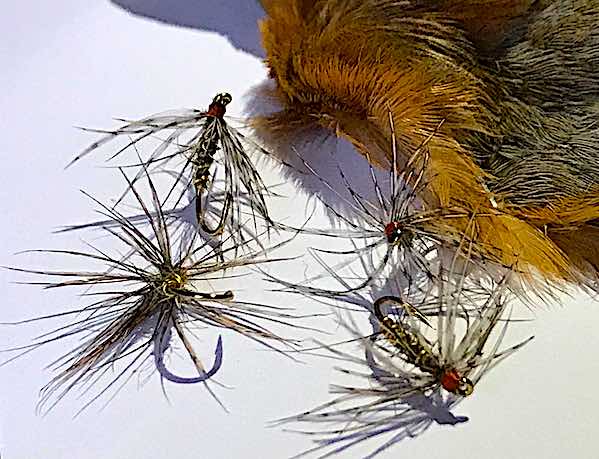
A subset of wet fly fishing using sparsely tied North Country Spiders. A very effective method for catching grayling at the start and during a fly hatch, especially when fish are taking the flies subsurface as the hatch.
Full Guide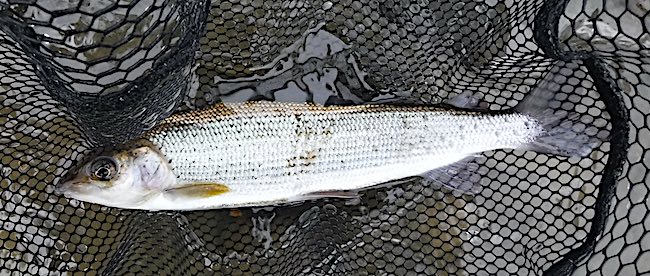
Dry-fly fishing for grayling can be some of the most exciting sport you'll have on a river. Great during autumn hatches and mild evenings
When fish start rising, take a moment to watch before you cast. Look at which way fish are moving, the size of the naturals on the water, whether fish are taking emergers or fully hatched adults, how often they're rising, and the pace of the current. A small, accurate cast will consistently outfish repeatedly covering rising fish with a fly that's too big.
Grayling are opportunistic feeders and will take a surprisingly wide range of patterns. There's no single "best" grayling fly — successful anglers carry a small, proven selection and adjust size, weight and colour to the water in front of them, rather than chasing the next pattern.
Below is a selection of my go-to nymphs, spiders, and dry flies for grayling fly fishing

Pheasant tail nymphs tied in a range of styles are about as good an all-rounder as you'll find, and a sensible starting point if you're not sure what to fish.
View Guide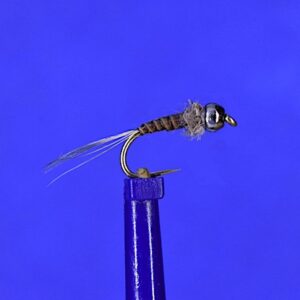
Perdigons come into their own when you need to get down fast and stay in contact fishing tight to the bottom
View GuideColour is worth paying attention to as well. Grayling can show a real preference for a particular shade, especially when natural food is abundant — pink and other shrimp-inspired patterns are consistently useful on the rivers I fish.
Rather than carrying dozens of grayling patterns, I'd rather carry a smaller box that covers size + weight + colour + profile. That gives you far more flexibility on the day than sheer numbers of flies ever will.
Traditional wet flies and North Country spiders are an important part of grayling fishing, particularly on rivers like the Dee and Ribble. Soft-hackled patterns imitate emerging insects and give a natural movement in the current that fish find hard to resist. Don't assume modern nymphing has made them redundant. See my guides to wet fly fishing and tying and fishing North Country spiders for more detail.
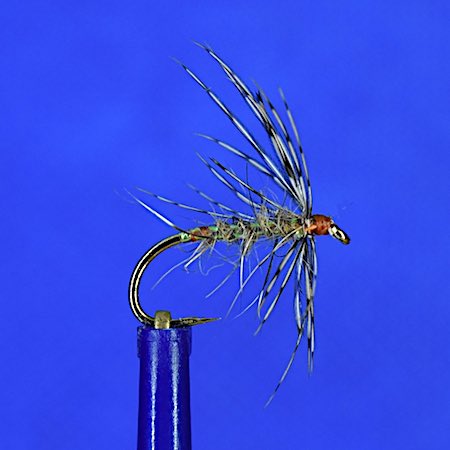
The March Brown slide tied with either a gold or pearl rib is a great imitation of olives. One of my favourite wet flies that I'm never without.
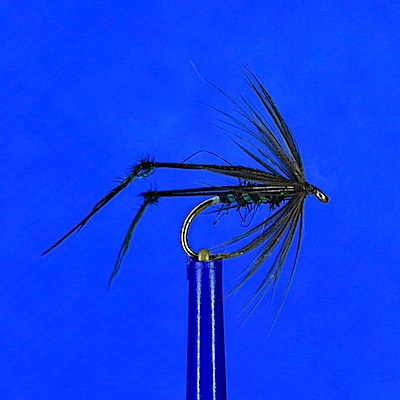
The black hopper wet fly holds pole position in my fly list. It’s a great, universal fly pattern and I'm never without few in my fly box because rarely a month hasn’t gone without it catching grayling.
View Guide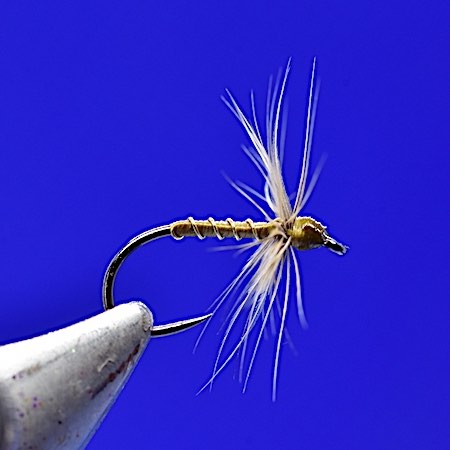
The Greenwlls Glory spider is another great grayling fly. I find it best fished on the top dropper of a team of three spiders.
Grayling will rise readily to the dry flies especially when there is a fly hatch on. Watch the water for small dimples, fish showing near the surface, emerging insects, or surface disturbance in otherwise steady water. If grayling are clearly up in the water, there's no reason to keep fishing a heavy nymph just because it worked earlier.
It is best to try and identify the hatching flies and use a suitable imitation. If that not possible the try a general dry fly pattern. The following three dry flies catch plenty of grayling throughout the season on the Welsh Dee and River Ribble.
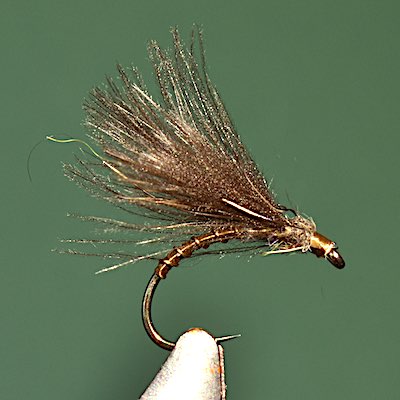
The CDC Olive is a great dry fly to tie on when grayling are feeding on hatching small olives and Iron Blue Duns. I’ve been using this pattern for many years and found it’s a great dry fly for catching grayling throughout the season.
View Guide
The Grey Duster fly sits on my short list of the greatest dry flies to have been invented. For over 40 years, this classic dry fly has produced the GOODIES for me on most of the rivers I’ve fished, especially the Dee, Eden, Ribble, and Wharfe.
View Guide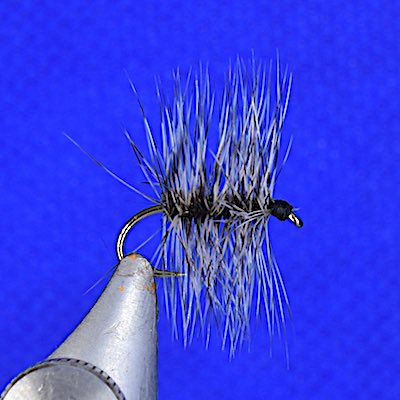
The Griffith’s Gnat is a versatile fly pattern for catching grayling feeding on midges.. It’s a fantastic fly for a beginner to tie because of its simplicity and usefulness for fishing on rivers.
View GuideYou don't need complicated or expensive kit to enjoy grayling fishing. A light, simple outfit will do the job on most UK rivers, and it's far better to buy a few sensible items than a bag full of gadgets. Here's what I'd put together if I were starting from scratch.
The reel's main job is to hold your line, so a simple, reliable model is plenty. Grayling rarely make the long, screaming runs you'd get from a salmon, so you don't need a sophisticated drag. Make sure it balances reasonably with your rod and fits your line weight.
A floating fly line matched to your rod's rating (so a WF3F on a #3 rod) covers almost everything you'll do. "WF" means weight-forward, a standard profile that casts well and is easy to learn on. If you plan to fish mostly with Czech or Euro nymphing, you'll often use a very thin level line or just a leader. That's something to explore later, though, rather than at the start.
Grayling can be leader shy in clear, low water, so aim for a delicate presentation whichever fly fishing method you chose. They can be surprisingly selective on river that see a lot of angling pressure. In these situations it's best to use the finest leader tippet possible.
Dry fly fishing: Beginners should start with a ready made 9ft copolymer tapered leader and add 3-4ft of 6X fluorocarbon tippet (3 to 3lbs). I apply floating to the tapered leaded and degrease the fluorocarbon tippet section, which mades the end section less visible to the fish.. Experienced anglers can lengthen the tapered leader section to 12ft, or switch to a furled leader for gentle turnover on slow, glassy pools.
Wet fly fishing: For beginners I would recommend fishing a single wet fly or spider on a 7ft 5X copolymer tipped 3ft of 6X copolymer tippet. For experienced anglers, I would recommend adding two 3ft sections of 6X tippet to form two droppers, so a 3-fly set-up van be fished.
Nymph fishing: Beginners should start fishing nymphs on a 7ft 5X tapered leader tipped 3 to 5ft of 6X fluorocarbon tippet which sinks faster than copolymer. You can add a small coloured sighter to the leader to aid take detection. After gaining experience you should try tight-line . Euro-style nymphing.
As a general rule fish fine in clear slow water.
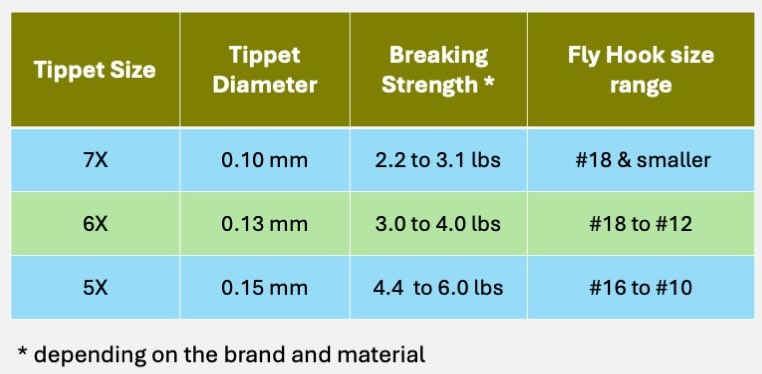
Fine tippet improves presentation but demands more careful playing of the fish, More often that no I find that most situations can be covered using 5X and 6X tippets ( ca. 3lbs to 5lbs breaking strength), and sometimes dropping to 7X when fishing is tough in clear water.
In general you should match your leader stength to fly size, water clarity, technique, current strength, fish size and how much vegetation or structure is nearby. A delicate presentation is valuable, but there's no benefit in tippet so fine you're regularly breaking fish off.
These are one of the most useful bits of kit you can own. Polarised lenses cut the glare off the water so you can see into the river, spot the riverbed, see depth changes and, sometimes, the fish themselves. They also protect your eyes from a stray fly.
A net helps you land fish quickly and handle them as little as possible, which is better for the grayling. A net with a soft, fish-friendly rubber mesh is kinder than coarse knotted mesh. A lightweight net with a magnetic clip or lanyard is easy to carry without it getting in the way.
Goldhead Hare's Ears are similarly as versatile as PTNs.
You don't need premium kit to catch grayling. A decent mid-range rod, reel and line combination, a few leaders, a modest selection of flies and a pair of polarised glasses will give you everything you need. Spend your money first on waders and boots that fit well and keep you safe and warm, and then on a good rod. Upgrade the rest as your skills and preferences develop.
Q. What is the best fly for grayling?
A. There isn't a single fly that's always best. Pheasant Tail Nymphs, Hare's Ears, jig nymphs, Perdigons, spider patterns and small dry flies are all useful depending on conditions.
Q. What time of year is best for grayling fly fishing?
A. Autumn and winter are the classic grayling seasons, largely because they provide sport when many trout fisheries are closed — though fishing quality varies by river and local regulations.
Q. Can you catch grayling on dry flies?
A. Yes. Grayling can be excellent dry-fly targets when they're feeding near the surface, particularly during a hatch or on milder days.
Q. Are grayling difficult to catch?
A. They can be, especially on clear or heavily fished rivers. Reading the water, controlling depth and improving presentation make the biggest difference.
Q. What size fly rod is best for grayling?
A. A light 2–4 weight rod around 9–10 ft is a good starting point, though the ideal setup depends on the river, technique and conditions.
Q. Where do grayling hold in winter?
A. Deeper glides, pool tails and steady runs — anywhere the current delivers food without excessive turbulence.
Q. Do grayling shoal?
A. Yes. Grayling commonly group together, so finding one fish is often a good sign there are more nearby.
Grayling fly fishing is about far more than finding the right fly. The anglers who catch them consistently are the ones who understand the river, know where fish are likely to hold, and can present a fly naturally at the correct depth — whether that's easing a nymph through a deep winter glide, working spiders through a run, or watching a grayling rise to a tiny dry on a mild autumn afternoon.
If you're just starting out, keep it simple: find likely water, fish the correct depth, keep your presentation natural, and pay attention to what the river is telling you. The more time you put in, the more you'll understand why grayling have earned their reputation as the Lady of the Stream.