Synopsis
Daytime sea trout fishing on the Welsh Dee is often overlooked, yet it can provide outstanding sport when approached correctly. This guide explains when to target sea trout during daylight hours, the river conditions that produce the best results, the tackle and fly patterns that consistently catch fish, and the types of water where sea trout are most likely to hold.
Whether you’re new to sea trout fishing or looking to improve your success on the Welsh Dee and other freestone rivers, these proven tactics will help you fish with greater confidence.
Introduction
Many anglers associate sea trout exclusively with night fishing, but that isn’t the only way to catch them. On many rivers, sea trout can be successfully targeted during the day, particularly in the right weather and water conditions. This is particular helpful if you’re not comfortable with fishing at night
Over many seasons of fishing this remarkable river, I’ve discovered that careful presentation, stealth, and understanding where fish lie can produce excellent daytime catches. In this guide, I’ll share the methods, tackle setups, flies and locations that have consistently worked for me, helping you make the most of the relatively short but exciting sea trout season.
I bet once you’ve experienced the exhilaration of catching a sea trout it will be hard…
to resist becoming addicted to fishing for sea trout.
The prime sea trout fishing on the Welsh Dee is short, from July to the middle of September. So, every year during this period, I focus on fly fishing for sea trout at Llangollen.
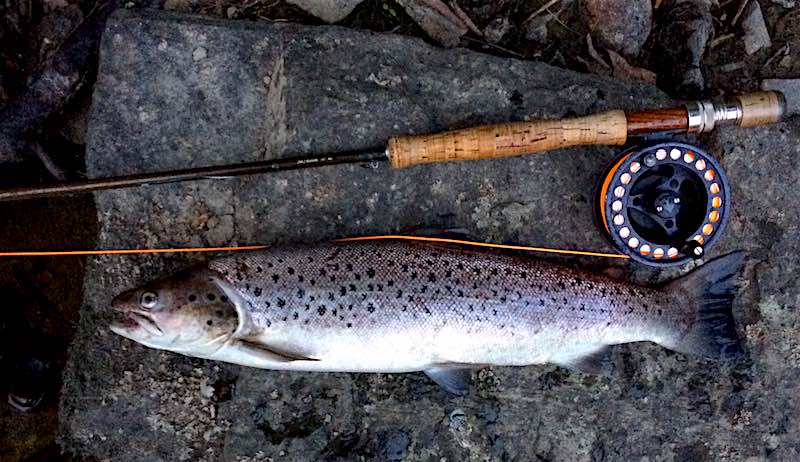
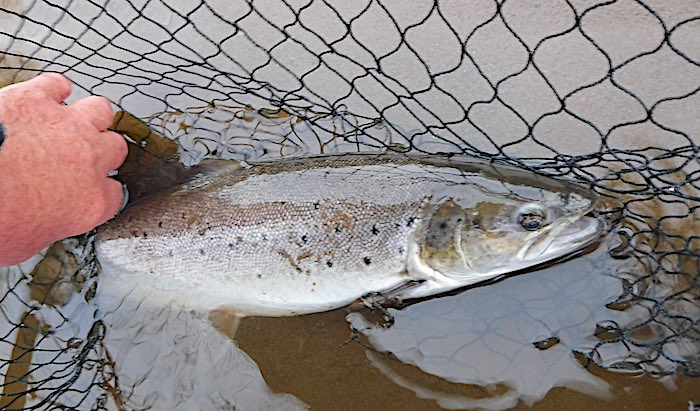
The Welsh Dee has an estimated annual run of 10,000 sea trout, with an average size of about 1-2 lbs. In addition, it’s not uncommon to land large sea trout (4 – 8 lbs) and occasionally a double-figure specimen.
Therefore, it’s surprising that I often have the Welsh Dee at Llangollen…
to myself when fishing for sea trout.
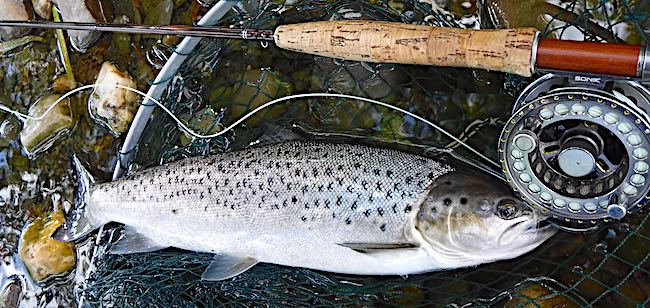
Maybe because it seems difficult to fish the Welsh Dee at night, or busy lifestyles do not lend themselves to night fishing.
However, it is possible to start your sea trout fly fishing journey during daylight hours and have some great fishing in the process.
This article provides information to encourage a few more anglers to try fly fishing for Welsh Dee sea trout.
Here’s how…
Daytime sea trout – how to catch them:
Almost every year, on the Welsh Dee, the signal for the main run of the sea trout happens in June.
It usually comes out of the blue while fishing for grayling and trout with either dry flies, wet flies, spiders or nymphs on a light leader (ca. 3lb).
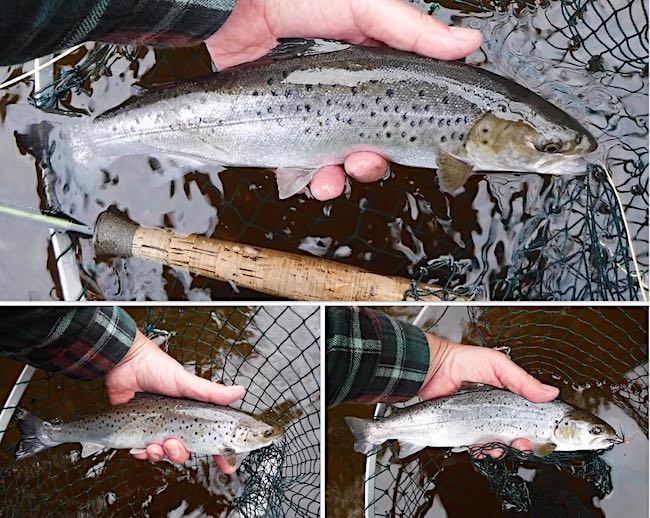
Last, I caught my first sea trout (ca. 2lb) of the season while nymphing for trout at 5 pm during June. I cast a size 16 gold ribbed hare’s ear in front of a large boulder and as the fly swung around…
A sea trout smashed the fly and took off downriver.
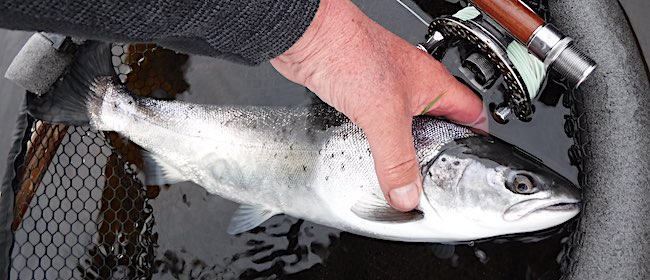
Then, later the same day, I caught another sea trout nymphing a fast run further downriver.
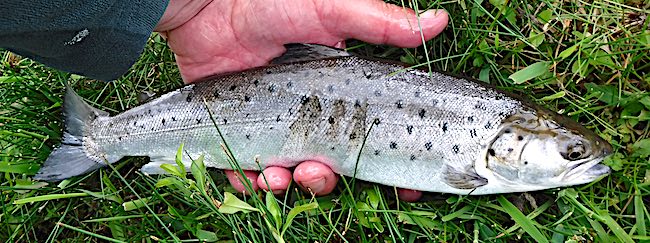
From then to the end of September, you have a great opportunity to catch daytime sea trout when the conditions are favourable.
On sunny days, it is best to focus your daytime sea trout fly fishing during the first couple of hours of daylight and the last 3 hours of daylight. With dull, overcast days offering you the best chances of catching daytime sea trout.
What Fly fishing tackle is required for daytime sea trout?
It depends on the river conditions.
When the river is running clear and close to its summer level, the fishing tackle I use for daytime sea trout is the same as I use for grayling or brown trout fishing, i.e.
- 9ft or 9ft 6” rod, 5 or 6wt
- Floating line
- 7ft, 6X tapered copolymer leader tipped with 6ft of 3lb copolymer
- 3 droppers spaced 3ft apart
If the river is running off after a summer spate and
- 10ft 6wt rod
- Floating or intermediate line
- 7ft, 2X tapered fluorocarbon leader tipped with 4ft of 6 to 8lb fluorocarbon
- 2 droppers spaced 4ft apart
What daytime sea trout flies to use?
When the river is running clear at its summer level:
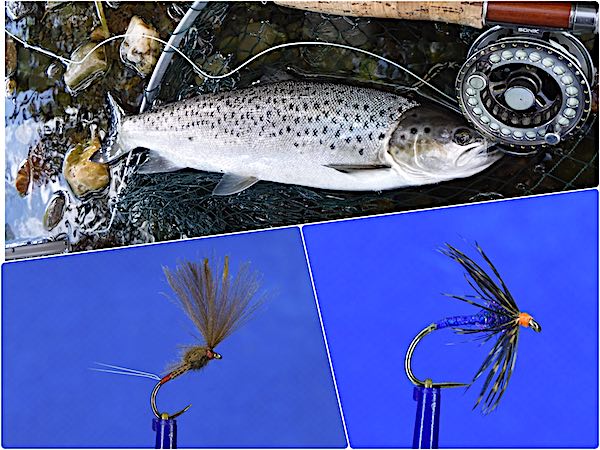
For many years now, my preferred daytime sea trout flies is a team of wet flies: a March Brown spider on the point, a black hopper middle dropper, and a brown & silver sedge top dropper (sizes 14 or 12).
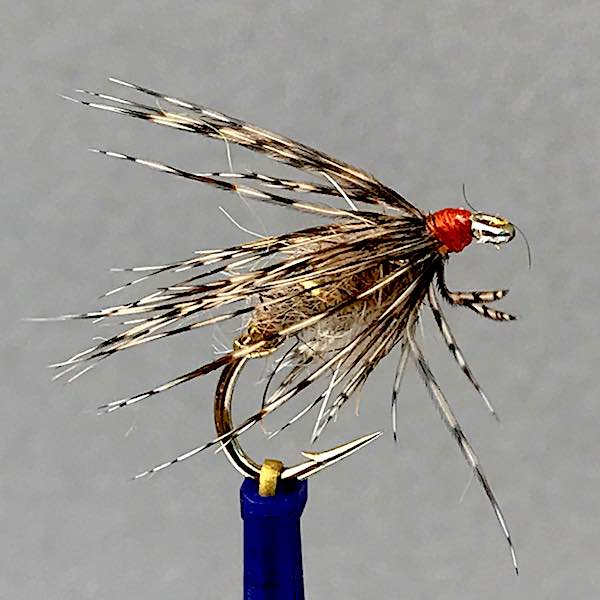
March Brown Spider
- Hook – Kamasan B170 size 14 & 12
- Thread – rusty red UNI 8/0
- Body – Hare’s ears
fibres of varying length &colour - Rib – medium oval gold tinsel
- Hackle – brown partridge neck
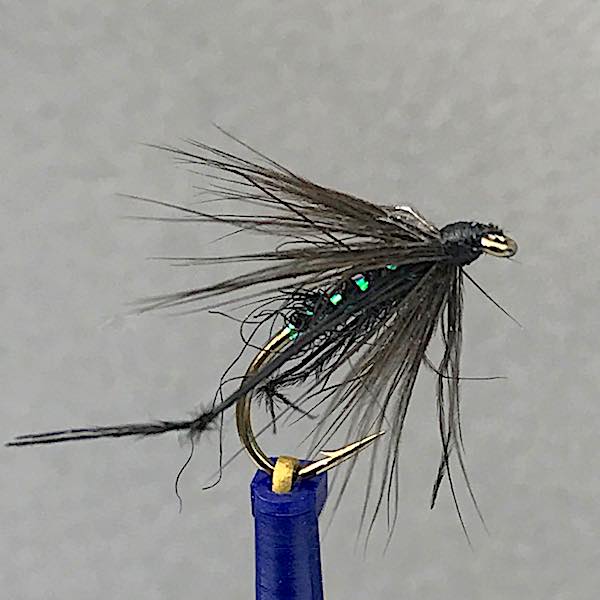
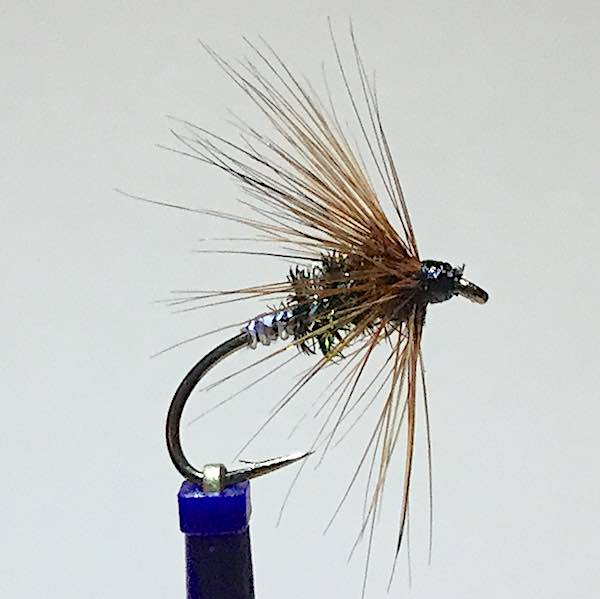
Black Hopper
- Hook – Kamasan B170 size 14 & 12
- Thread – black UNI 8/0
- Body – black seal’s fur
substitute - Rib – Uni Pearl Mylar #14 (1/32)
- Legs – knotted pheasant tail dyed black
- Hackle – Black Hen
Brown & Silver Sedge
- Hook – Kamasan B170 size 14 & 12
- Thread – black UNI 8/0
- Body rear – medium silver tinsel
- Body front – Peacock Herl
- Rib – fine oval silver tinsel
- Hackle – Brown cock
Having read the article on “bling” spiders in Flyfishing and Flytying by Neil Darling (March 2018 Ed.) I have been testing some of these patterns. So far, I’ve had some sea trout success with a couple but it’s still very much a work in progress.
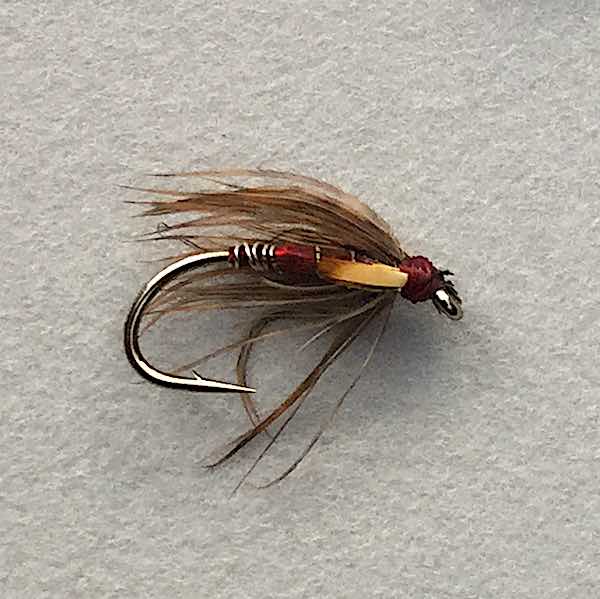
Red Bling Spider
- Hook – Kamasan B170 size 12 & 10
- Thread – red UNI 8/0
- Body – holographic red
- Rib – fine silver wire
- Hackle – Grouse neck
- Cheeks – split jungle cock
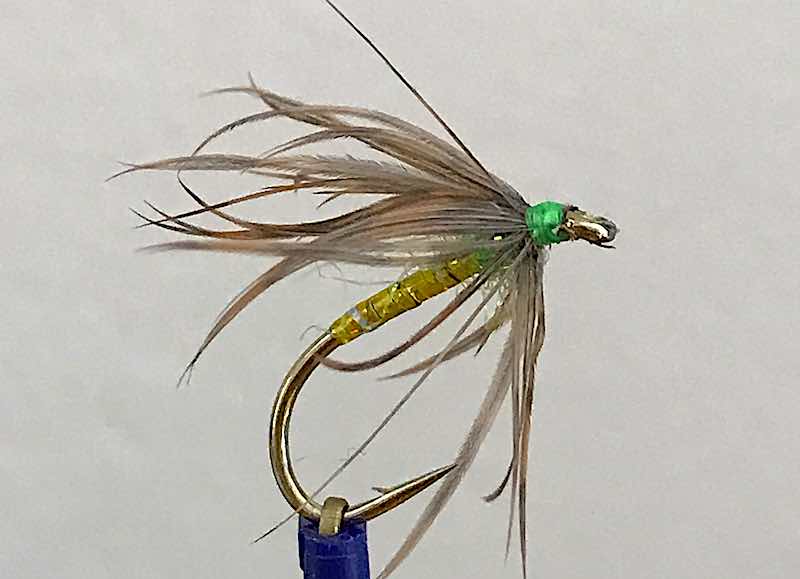
Grouse & Olive Bling Spider
- Hook – Kamasan B170 size 12 & 10
- Thread – fluoro-green
- Body – holographic chartreuse
- Thorax – green Hends Spectra dubbing code 89
- Hackle – Grouse neck
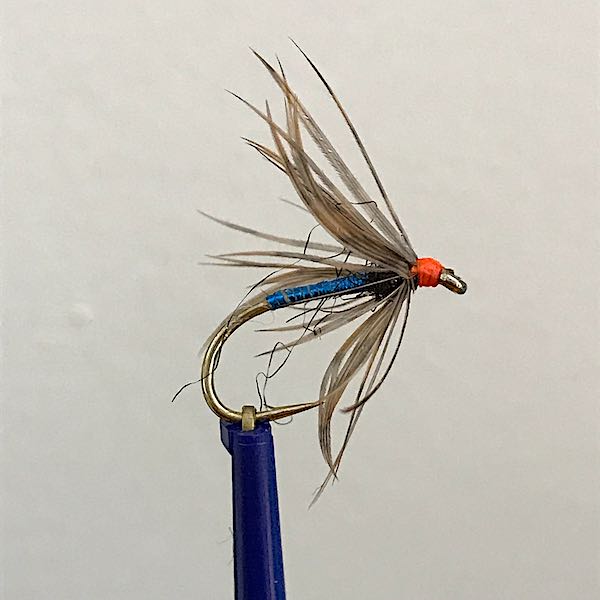
Grouse & Blue Bling Spider
- Hook – Kamasan B170 size 12 & 10
- Thread – fluoro-orange
- Body – holographic blue
- Thorax – purple Hends Spectra dubbing code 411
- Hackle – Grouse neck
It is also possible to catch sea trout while tight line nymphing and the following video highlights this…
When the Welsh Dee is running off after a summer spate and is still coloured:
If the river is
- Silver Stoat’s Tail,
- Stoats Tail,
- Curry’s Red Shrimp
Where to fish for daytime sea trout at Llangollen
I’ve not had much luck trying to spot sea trout on the Welsh Dee, unless they are jumping in the evening. Therefore, my approach is to find likely lies that offer shelter and fish them.
River features that provide good sea trout lies include:
- Undercut riverbanks
- Overhanging tree-lined banks
- Weed beds and underwater obstacles
- Boulder-strewn fast water channels
You need to approach likely lies with stealth because sea trout, like sizeable brown trout, are easy to spook.
If possible, avoid wading into the river. However, I’ve found that to reach some of the lies, it is necessary to wade, and if this is done carefully, you can still catch sea trout.
Over many years, I’ve built up knowledge of where sea trout usually lie and can be caught during daylight on the Welsh Dee at Llangollen; these include:
- Top Pool (tail)
- Dee Farm (head)
- Hollybush Pool (tail)
- Duncan’s Pool
- Horseshoe Falls (top section)
- Mill Run (far bank)
If you fish the above places either early morning or evening, you will eventually catch a daytime sea trout. Note – if you don’t catch a sea trout within 15 minutes of fishing in one spot, move on to the next place.
Key Takeaways for Daytime Sea Trout fishing
- Daytime sea trout fishing on the Welsh Dee is most productive from July through to mid-September.
- Early mornings, late evenings and overcast days offer the best chances of success.
- In clear summer water, standard trout or grayling tackle is usually sufficient, while coloured water after a spate calls for stronger tackle and leaders.
- Traditional wet flies, spiders and small nymphs consistently catch daytime sea trout, with small salmon flies becoming effective when the river carries colour.
- Focus on likely holding areas such as undercut banks, boulders, weed beds and fast channels, and fish each spot methodically before moving on.
- Above all, stealth and mobility are essential—approach each lie carefully, avoid unnecessary wading, and keep searching until you locate active fish.
Conclusion
While sea trout are often regarded as a species best pursued after dark, the Welsh Dee regularly proves that productive fishing can also be enjoyed during daylight hours. Success comes from understanding the river conditions, approaching each pool with care, and adapting your tackle and fly selection to suit the water and the fish’s behaviour.
Patience, observation and mobility are just as important as casting ability. By focusing on likely holding areas, fishing methodically and making the most of favourable conditions, you’ll greatly increase your chances of connecting with one of the Dee’s hard-fighting sea trout.
Whether you’re trying daytime sea trout fishing for the first time or refining techniques you’ve used for years, every session on the river offers an opportunity to learn something new. With the right preparation and a willingness to adapt, the Welsh Dee can provide some truly memorable fishing throughout the summer season.
If you are interested in fly fishing for sea trout on the Welsh Dee, there are some excellent Day Ticket options
Good Luck and…
Please contact me if you have any questions. Also, take a look at part 2 covering how to approach night-time fishing for sea trout fishing.
Another very informative article . One of my best sea trout was caught on a very sunny morning around 10 am , that took one of my favourite flys black and silver size 10 on River Nith.
Top article – My very first fish caught on the fly (#14 Dry Black Gnat) a 1lb sea trout from a small Donegal stream next to to our caravan site. This was 40+ years ago and still can remember clearly to this day the cast to what I thought was a rising brownie, the drift and then the take which was a mere sip, then all hell breaking loose. On a 3lb tippet I was all over the show running up and down the bank, no net panicking but luckily I was able to beach it on the sandy inside bend of the bank. Over the years I have had great daytime sport for sea trout ignoring the advice of many that they were uncatchable during low water. Used small #12/14/16 dries, wets and also the plain old pheasant tail nymph fished upstream and pitched into the pots and next to the seams of fast and slow water, if that makes sense was deadly at times. If you scale things down and dont go crashing about bankside they are catchable, not easy but not impossible.
I get alot of sea trout on klinhammers and black emergers during day time also white beaded nymphs work well,,
Hi Joe,
Thanks for the comments, I’ve not tried white beaded nymphs before but will give them a try on the Welsh Dee.
Tight lines, Andrew
Hi Andrew,
Really enjoyed the read plus the video. I can see from earlier post the length of leader being used if clear/coloured. Being a bit green on river fishing especially for Sea trout, I’m using furled leaders with a leader on this. how would I go about this and would these flies work on any given river as I’m in Cornwall and fishing the Fowey?
Hi Barry,
Using the furled leader set-up you mention should be fine but you need the total length to be 10-12ft. The flies mentioned should work on most rivers.
Tight lines, Andrew
Hi Andrew, can you confirm that you are using 13 and 11 ft leaders in this article ?
Also, if you were fishing the Clwyd what would you scale them down too ?
Hi Stephen,
The total length of the leader with 3 droppers is 13ft (7ft tapered and 6ft of 3lb tippet) when fishing on the Dee in clear water. If there is colour in the water I normally fish 11lb fluorocarbon on a 7ft sink tip because there’s always a chance of hooking a salmon or a bigger sea trout. If there are a lot of snags where you fish, then it’s probably best to scale up to a 6lb tippet.
I hope this helps, Andrew
I read your article on Welsh Dee Sewin flies and the Joe Pye fly. From memory- this came from a book by James Waltham who fishes the Ribble/ Hodder- excellent book BTW. In his book the fly was called a ‘ red arsed Joe Pye’ . I have tied a few but never used- so good to hear they work. I believe Waltham also devised the snake fly.
Hope this helps!
Best
Damian
Hi Damian,
Thanks for the background on the Joe Pye. I find it works best on the Dee in late August when the sea trout have been in the river for a while. Tight lines, Andrew
Hi Andrew
Thoroughly enjoyed the post. Can relate a lot to using spiders for Sea Trout in the daytime. Have had similar success with the. Long time ago. Think I need to start using them again, brings back memories.
Cheers George
Hi George,
Great to hear you enjoyed the blog and thanks for your comments.
If you try spiders again I hope they bring you some success.
Tight lines, Andrew